Waymo’s Miami Robotaxis Just Pulled Ahead of Tesla’s Cybercab
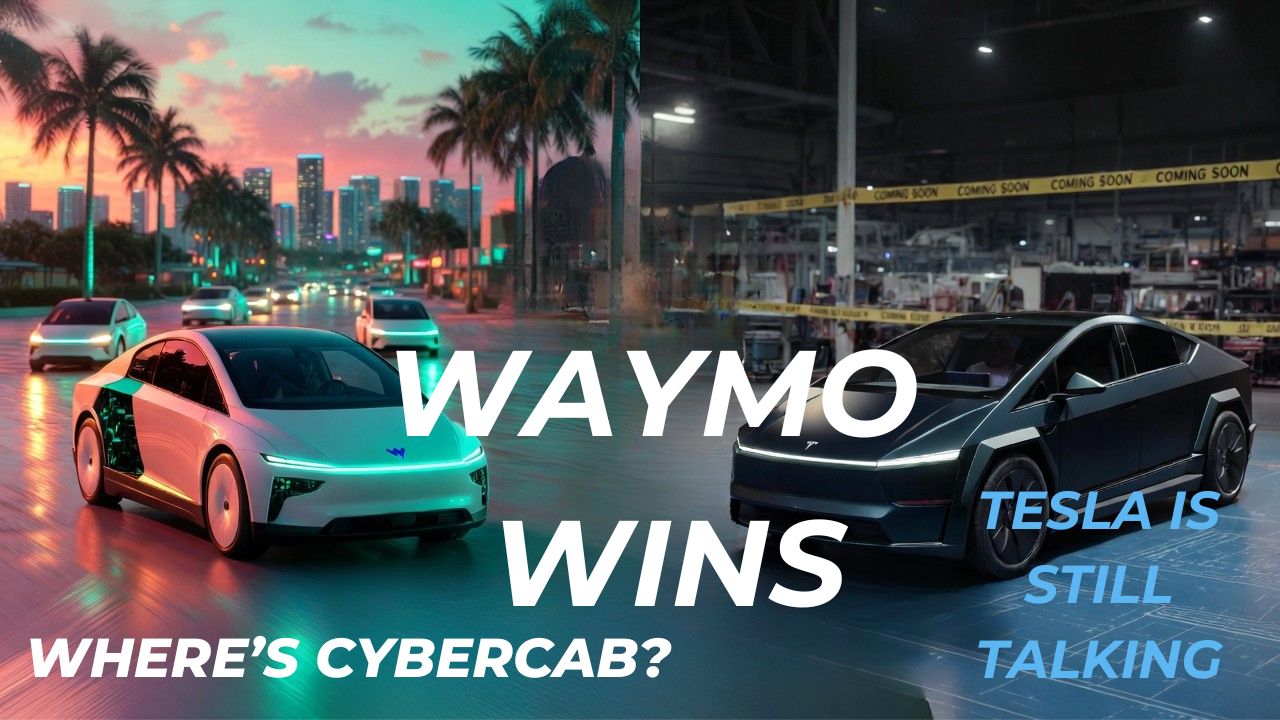
Waymo has officially turned Miami into its next fully driverless robotaxi city, and the numbers are hard to ignore. The Alphabet-owned company is now running paid rides across a 60-square-mile service area with thousands of locals signed up to try it, while its total weekly robotaxi trips have crossed the 450,000 mark across U.S. markets. At the same time, Waymo is preparing a multibillion-dollar funding round to fuel a 2026 expansion into more than ten additional cities plus its first international markets, leaving Tesla’s still-unlaunched Cybercab trying to catch up.
What Waymo Just Switched On in Miami
Waymo’s Miami launch is not a limited pilot; it’s a full commercial rollout open to paying riders. The company has activated a roughly 60-square-mile service zone that covers major neighborhoods like the Design District, Wynwood, Brickell, and Coral Gables, with plans to extend service to Miami International Airport next. Testing in Miami started well before launch, and now the service joins Phoenix, San Francisco, Los Angeles, Austin, and Atlanta as one of Waymo’s fully driverless markets.
Thousands of Miami residents have already joined the waitlist or been invited to ride, and new riders will be added on a rolling basis through the Waymo app. Local fleet operations in the city are supported by partner firms that handle charging, cleaning, and maintenance to keep vehicles in constant rotation. This launch effectively opens Waymo’s 2026 expansion campaign and further cements its early lead in U.S. robotaxi deployment.
The Scale: 450,000 Weekly Rides and Climbing
Miami’s launch sits on top of a major scale milestone for Waymo: roughly 450,000 weekly paid rides across its network. That figure is nearly double what the company was doing at the start of 2025 and reflects tens of millions of rider-only trips completed without a human driver in the car. For investors and regulators, this is no longer a small experiment. It is a transportation system with real usage and real-world safety data behind it.
Behind those ride numbers is a broader expansion roadmap. Waymo is targeting around one million weekly trips by the end of 2026 and is preparing to add more than ten new U.S. cities, including large metros in Texas, the Southeast, and the Midwest. The company is also testing vehicles in additional markets and is planning to make London and Tokyo early international anchors, turning the Miami launch into one node in a much larger network.
The Money Behind the Robotaxis
To fund all of this growth, Waymo is pursuing a new funding round measured in the tens of billions of dollars, with reporting pointing to a raise of more than $15 billion at a valuation near or above $100 billion. Alphabet is expected to anchor the round, with participation from major institutional investors who view robotaxis as a long-term infrastructure play rather than a speculative gadget bet.
Since 2020, external funding into Waymo has already totaled well into the double-digit billions, making it one of the best-capitalized autonomous vehicle programs in the world. The new capital is earmarked for fleet growth, new markets, and a gradual transition from converted passenger vehicles to purpose-built robotaxi platforms designed for 24/7 commercial duty. With a goal of operating across well over a dozen cities by 2026 and capturing a meaningful slice of the rideshare market by the end of the decade, Waymo is positioning itself as a direct competitor to traditional ride-hailing, not just a tech demo.
Where This Leaves Tesla’s Cybercab
Tesla, meanwhile, is still working to bring its Cybercab robotaxi from prototype to real-world service. The dedicated Cybercab vehicle was unveiled with promises of a sub-$30,000 price point and production starting around 2026. Since then, Tesla has delayed its next-generation self-driving computer to later in the decade, which means early Cybercabs are expected to launch on current-generation hardware rather than the newer platform originally envisioned.
More recently, Tesla’s leadership has warned that Cybercab production will start “agonizingly slow,” with a gradual ramp-up rather than an immediate large-scale rollout. Tesla has run branded FSD and early robotaxi-style programs in cities like Austin and in parts of California, but these still rely on human operators, supervision, or limited conditions and do not match the fully driverless, commercial model Waymo is already running in multiple cities. In practical terms, Waymo is selling rides today while Tesla is still iterating on hardware, software, and production plans.
Why Miami Is the Real Test Case
Miami is an important proof point because it is a very different environment from the dry, gridded streets of Phoenix or the dense but temperate neighborhoods of San Francisco. The city has a mix of dense urban cores, sprawling suburban zones, heavy tourist traffic, and a reputation for aggressive and unpredictable driving, all wrapped in hot, humid weather that can be harsh on sensors and hardware.
Waymo’s decision to launch here—and to start planning airport service—signals confidence that its perception, mapping, and planning stack can handle more chaotic, real-world conditions. If fully driverless service can operate reliably in Miami’s mixed traffic and complex road network, it strengthens the argument that robotaxis are ready for broader deployment beyond carefully curated tech hubs. It also increases the pressure on competitors that are still operating in more limited geographies or under tighter supervision rules.
What This Means for Drivers, Riders, and Cities
For everyday riders, Waymo’s Miami launch offers a glimpse of a future where hailing a driverless car is as normal as ordering food delivery. In dense urban corridors, a reliable robotaxi network could make owning a second car—or any car at all—less necessary, especially as ride prices start to compete with the total cost of fuel, insurance, parking, and maintenance.
For professional drivers and fleet operators, it is a clear signal that a shift is coming. The timeline may still be measured in years, but the direction is hard to ignore now that hundreds of thousands of paid rides are happening each week without a human driver. Cities will have to adapt as well. Regulators are weighing safety data, congestion impacts, and curb management as robotaxis scale, while transit planners explore how on-demand autonomous rides can complement buses and trains instead of trying to replace them entirely.
With Miami now live, weekly trips at large scale, and more cities on deck, Waymo’s latest move suggests that the autonomous future is no longer hypothetical. It is rolling out, one city at a time, and the race for who will own that future is very much underway.



.jpg)










.jpg)